VSME — Sustainability Reporting for SMEs
Can provenance infrastructure turn a compliance burden into a trust advantage?
The scenario
Bjork Metall AB is a 25-person metalworking shop outside Boras. Their largest customer — a CSRD-bound manufacturer — now requires ESG data from their entire supply chain. Bjork Metall has received three different questionnaires in three different formats this quarter. They don’t have a sustainability department. They have Fortnox, an electricity contract with Vattenfall, and a payroll system.
Under VSME — the EU’s voluntary sustainability reporting standard for SMEs — Bjork Metall can produce one standardized report that replaces all three questionnaires. But the customer still has to trust the numbers. Where did the emissions figure come from? Did they use the right factors? Did they account for the new CNC machine?
The pipeline
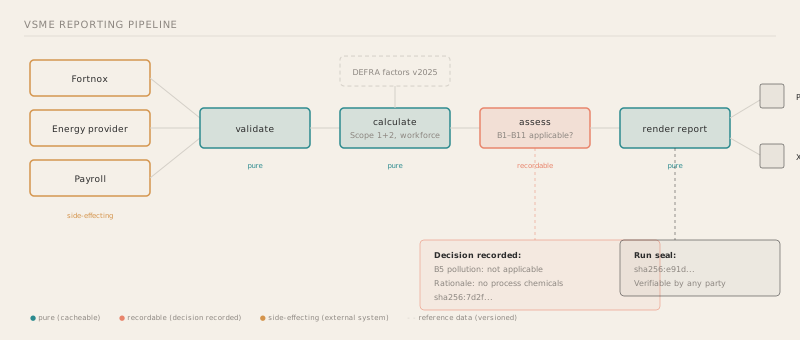
Fortnox ──→ ┐                                          ┌──→ VSME report (PDF/XBRL)
             ├─→ validate ──→ calculate ──→ assess ──→ render
Vattenfall ─→ ┤                                         └──→ sealed evidence package
             │                    │            │
Payroll ────→ ┘                   │            │
                                  │            └── "B5 pollution: not applicable
                                  │                 — no process chemicals used"
                                  │                 (decision recorded)
                                  │
                                  ├── Scope 1: 14.2 tCO₂e
                                  │   ├── company vehicles: 8.1 tCO₂e (diesel, 32,400 km)
                                  │   └── gas heating: 6.1 tCO₂e (natural gas, 28,000 kWh)
                                  │
                                  └── Scope 2: 3.8 tCO₂e
                                      └── purchased electricity: 186,000 kWh
                                          × 20.4 gCO₂/kWh (Vattenfall Nordic mix 2025)
Data sources (pulled from your systems):
- Fortnox API: revenue, vehicle fuel expenses, gas bills, classified expenses
- Vattenfall annual statement: kWh consumed, contract type, energy mix
- Payroll export: headcount, gender split, contract types, training hours
Calculations (same inputs always produce the same result):
- Scope 1: fuel consumption × DEFRA emission factors v2025 → tCO₂e
- Scope 2: kWh × supplier-specific emission factor → tCO₂e
- Workforce: headcount, gender ratio, training hours per employee
Applicability assessment (judgment call — rationale recorded):
- B1 Basis for preparation: applicable (always)
- B2 Practices: applicable (energy efficiency measures)
- B3 Energy and GHG: applicable (Scope 1 + 2 calculated)
- B4 Biodiversity: not applicable (urban industrial zone, no significant land use)
- B5 Pollution: not applicable (no process chemicals) ← decision recorded with rationale
- B6 Water: not applicable (domestic use only, no industrial water consumption)
- B7 Workers: applicable (25 employees)
- B8–B11: assessed individually…
Each “not applicable” is a recorded decision — not a skipped checkbox. Next year, if someone asks “why didn’t you report on pollution?”, the answer traces back to a specific assessment with a specific rationale, not a blank field.
Output:
vsme-report-bjork-2025.pdf— the human-readable report (sha256:a4f2…)vsme-report-bjork-2025.xbrl— the machine-readable XBRL (sha256:7c01…)seal.json— seals the entire pipeline (sha256:e91d…)
What you can ask afterward
| Question | How it’s answered |
|---|---|
| ”Where does the 14.2 tCO₂e Scope 1 figure come from?” | Trace the calculation: 8.1 (vehicles, from Fortnox fuel expenses × DEFRA 2025 diesel factor) + 6.1 (gas, from Vattenfall statement × natural gas factor) |
| “Which emission factors were used?” | Emission factor reference: DEFRA v2025 (sha256:b3c8…). Version locked — the same version used for all calculations in this report. |
| ”Why wasn’t pollution reported?” | Decision record for B5: “not applicable — no process chemicals used in metalworking operations, only cutting fluids captured in closed system" |
| "What changes if we update to DEFRA v2026 factors?” | The factor version updates → Scope 1 and Scope 2 recalculate → the report regenerates. Data collection and applicability assessments are unchanged — only the affected calculations re-run. Takes seconds. |
| ”Can we verify this wasn’t altered after the fact?” | Verify the seal: the run log is independently recomputable. If the final seal matches, the log is intact and unaltered. No proprietary software needed. |
Before and after
Today: Bjork Metall’s controller spends two days filling in three different questionnaires with the same numbers copied from different sources. The customer receives an Excel file. There is no way to verify the numbers. Next year, the controller does it again from scratch.
With provenance: Bjork Metall runs the pipeline once. The report goes to all three customers. Each receives the same sealed package. Numbers trace to source. Next year, the pipeline re-runs against new data — unchanged calculations reuse last year’s results, only new data flows through. The controller reviews the changes, not the whole report.
Looking for sustainability reporting practitioners and Swedish SMEs facing value chain ESG data requests. [Contact →]